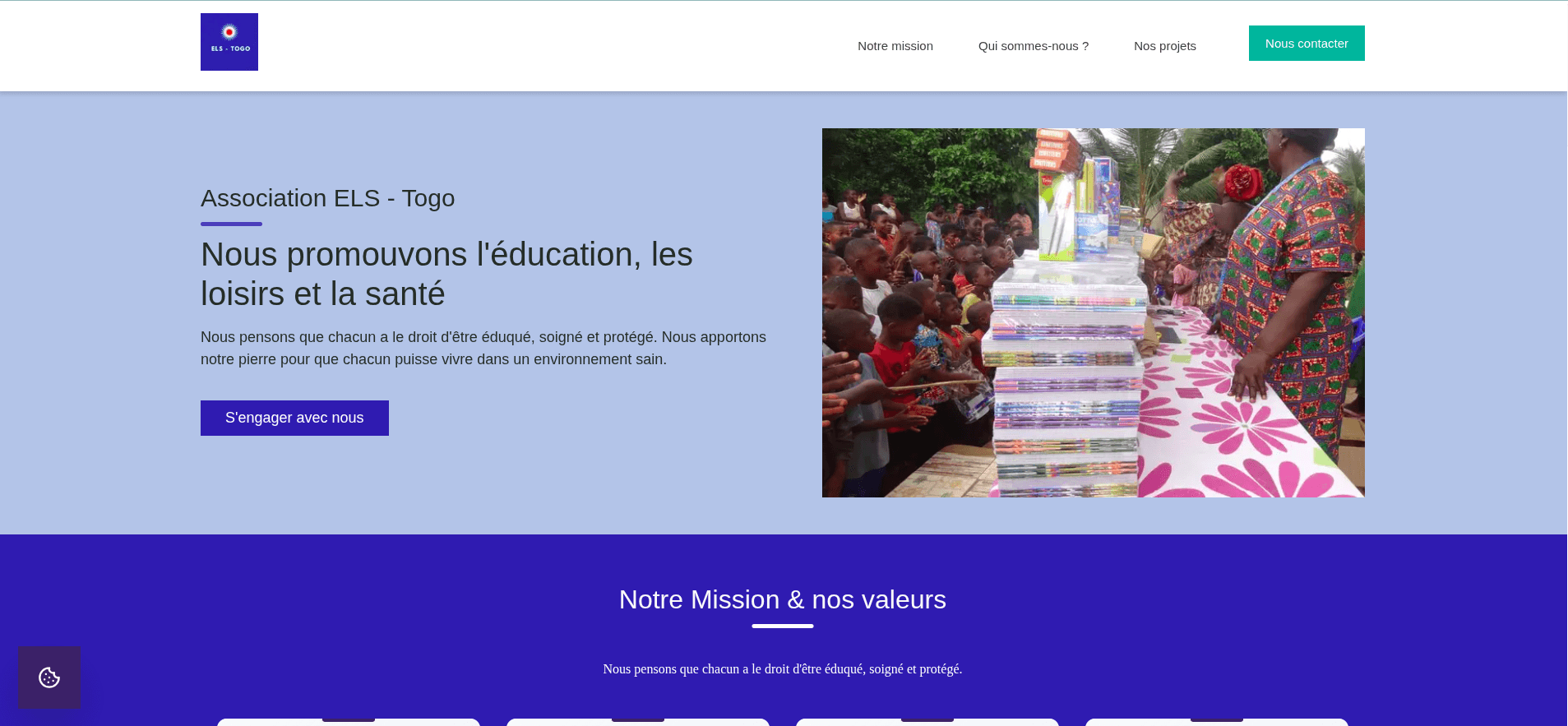






The context
The ELS Togo association has grown significantly through social networks and now wants to become more visible online. That is why I offered to help on a voluntary basis.
I chose the Next.js framework for its performance and because it matched my skills, so I could design the site quickly alongside my studies and work-study program. During this first client interaction, I learned how important it is to define requirements clearly and to be highly pedagogical: the client is far from the tech sector, which is a rewarding communication challenge for me. Our exchanges also take place remotely — I am in France, he is in Togo, in Tsévié.
I designed the site fairly quickly, then spent a long time training the client to use the Sanity back office. He can add content, define section copy, add team members or not, present projects, and even has some UI/UX choices.
The site is still under construction: the person in charge within the association is taking on more and more responsibilities in the social and solidarity economy (ESS) at regional level (Togo and neighbouring countries). These major commitments take a lot of his time and are the priority. Once he has updated all the content, you will be able to browse the site — it already exists, but is still inaccessible behind an authentication system because the content has not been loaded yet.
Next.js combined with Sanity CMS offers the best of both worlds for a site that does not need an overly heavy backend or a CMS as complex as WordPress. It was the ideal solution given the requirements:
What I learn :
- The lowest possible hosting cost for a zero-cost start (with room to scale according to traffic and the site's importance for the association): at this stage we chose Vercel and its generous free plan for MVPs, POCs, or simple showcase sites — an online business card, with no immediate scalability requirements.
- A CMS the developer can tailor to keep it as simple as possible for the client, giving them only what they need, with strongly customized guidance in the back office — always with controlled costs. Sanity meets that requirement; it is lightweight and works well with Next.js, which preserves performance expectations.
- Keeping the door open to evolution: good SEO, maintainability, scalability, etc., on a modern stack. That is why I did not propose overly simple systems and integrated a framework instead.